


Aistrium by Sprinterra
CASE STUDY · OPERATIONAL COORDINATION PLATFORM

A workflow automation platform built around the ERP

The operational dashboard and the internal requests queue on two laptops
  • 4–5 days

    Approval cycle, down from 15 business days

  • ~20

    Change requests a month at full adoption

  • 8–10

    Projects touched by a single change

Overview

As engineering-heavy manufacturers grow, a single engineering change starts touching more than one team can track by memory: engineering, supply chain, and project management all need to review it, assess which active projects and supplier components it affects, and approve it in the right order. Aistrium automated that coordination directly around the ERP - giving engineering change the same structured workflow discipline the ERP already gives financial data, without customizing the ERP itself.

  • INDUSTRYIndustrial equipment manufacturing
  • WHAT IT REPLACEDEmail chains & manual cross-team coordination
  • WHAT WE BUILTEngineering-change workflow & approvals
  • APPROACHLayered onto the ERP, not built as a new system

The Challenge

A single engineering change, tracked across teams that do not share a system

As operations-heavy businesses scale, they hit the same wall: the ERP records the outcome of a decision (a part number, an order, a financial transaction) but not the coordination behind it. That coordination lives in email threads, meetings, and spreadsheets, and gets harder to track with every new project, team, or supplier.

For a global manufacturer of complex custom systems, that gap showed up around engineering change. Each change request needed review from engineering, supply chain, and project management to assess its impact on active projects and supplier components.

Approvals ran through long email chains, with no reliable way to confirm every stakeholder had reviewed a change in the right order. Supply chain updates were hard to track, especially when the same component appeared in multiple active systems.

Operational leaders had no clear view of which projects a change affected, and escalation was inconsistent, depending on someone remembering to flag it.

Workflow automation while an ERP stays unchanged

ERP systems are built and optimized for finance - orders, part numbers, transactions - not for the back-and-forth of cross-team review that happens before those records are finalized. Extending the ERP itself to automate that coordination tends to fight the platform's own design, and puts business-critical workflow logic inside a system whose upgrade cycle, licensing, and vendor roadmap are not built around it. Our approach:

  • Preserves the ERP as the system of record, rather than bending it to do a job it wasn't designed for

  • Gives the coordination its own automated workflow, built around how the business actually operates, not around what the ERP data model happens to support

  • Stays upgrade-safe on both sides: ERP upgrades don't risk breaking custom coordination logic, and the automation can evolve independently of the ERP release cycle

This isn't specific to one manufacturer or one industry. Any operations-driven business that has scaled past what email and spreadsheets can coordinate across engineering, supply chain, service, or project delivery runs into the same structural gap between what the ERP records and what the business actually has to coordinate to get there.

What Aistrium Built

Aistrium automated the coordination workflow around the client's existing ERP and engineering systems, so engineering, supply chain, and project data all flow through the same coordination layer instead of living in separate tools. Delivered in 7-8 months, in the $220,000 range for a platform of this scope.

  • 01

    Engineering change workflow

    Change requests are submitted, reviewed, and evaluated with cross-department impact analysis, tracking dependencies between engineering components, supplier parts, and active projects before a change is approved.

  • 02

    Configurable approval orchestration

    Multi-step approval sequences route automatically to the right stakeholders based on request type, affected components, and department, replacing manual email coordination.

  • 03

    Supply chain change tracking

    Supplier and component updates are centralized, with the automation identifying every project and team that needs to review a change when a shared component is affected.

  • 04

    Real-time operational dashboards

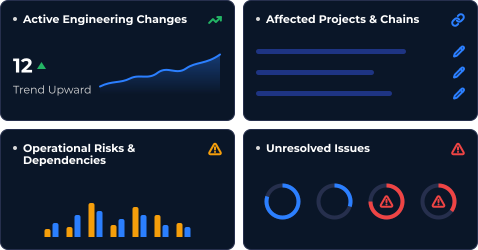
    Automated dashboards give leadership one place to see active engineering changes, affected projects, operational risks and dependencies, and unresolved issues.

  • 05

    Structured escalation workflows

    Operational and technical issues route automatically to the appropriate team and leadership level, instead of depending on someone remembering to forward an email.

  • 06

    ERP-preserving automation

    The automation connects to the ERP and engineering systems as the system of record; it does not customize or extend the ERP itself.

This is a repeatable pattern, not a one-off: engineering-change workflows, configurable approval orchestration, and real-time operational dashboards are automations Sprinterra has delivered independently across multiple engagements in manufacturing, real estate, and professional services.

  • Engineering Systems

    Change Requests, Technical Data, Component Revisions

  • ERP System

    Part Numbers & BOM, Orders & Financials, Production Planning

  • Supplier & Component Data

    Updates, Availability, Vendor Information

  • Project Execution

    Task Coordination, Approvals, Issue Tracking

OPERATIONAL PLATFORM

  • Engineering Change Workflow

    Submit, review, and track cross-department impact of change requests

  • Approval Routing Engine

    Configurable multi-step approval sequences routed by request type and department

  • Component & Dependency Tracking

    Map supplier parts to engineering assemblies and active projects

  • Operational Dashboards

    Real-time visibility into changes, risks, affected projects, and unresolved issues

  • Escalation Workflows

    Auto-route operational and technical issues to appropriate teams and leadership

  • Cross-Department Coordination

    Engineering, supply chain, and project teams aligned

  • Faster Decision Cycles

    Structured approvals replace email chains

  • Full Operational Visibility

    Leadership sees impact across all active projects

  • ERP Stays System of Record

    Platform coordinates, ERP manages financial and transactional data

Real-Time Dashboards

Leadership gains real-time visibility into engineering changes and project execution

Four dashboard tiles: active engineering changes trending up, affected projects, operational risks by week, and unresolved issues
Operational dashboard: engineering change requests, open ECRs by project and supplier alerts
Internal requests queue with approval levels and status per request

The Result

A structured workflow cut the approval cycle for a typical engineering change from ~3 weeks (15 business days) of email-driven review to 4–5 business days. At full adoption, the platform handled roughly 20 change requests a month. An average of 3 active projects touched per change, with some changes affecting as many as 8-10.

What this kind of automation changes

  • Before

    • Engineering changes tracked through long email chains, with no reliable record of who reviewed what, or in what order
    • Supply chain impact assessed manually, project by project
    • Leadership had no single view of which projects an active change affected
  • After

    • Every change request has a structured, cross-department review with a clear approval sequence
    • Supplier and component changes are traced automatically to every affected project
    • Real-time dashboards give leadership visibility into active changes, risk, and unresolved issues in one place
  • Why it holds up at scale

    • The ERP stays the system of record; the automation scales independently of it. New approval rules, departments, or product lines are added as configuration, and don't consume ERP user licenses or require a new ERP module.
    • Adding a new team, project, or supplier does not require rebuilding the workflow
    • Escalation is structural, not dependent on any one person remembering to flag it

Engineering-change coordination is one expression of a broader pattern: Aistrium builds workflow automation around ERP and core systems wherever the coordination that produces a business record is the part still running on email and memory.

Related case studies

  • The engineering change dashboard on a laptop

    A workflow automation platform built around the existing ERP

    A global manufacturer ran engineering change through email chains, with no reliable record of who reviewed what or which active projects a change affected. We built the review, approval, and impact workflow around the ERP instead of inside it, so supplier and component changes now trace automatically to every project they touch.

    • Structured cross-department review
    • Supplier and component changes traced automatically to every affected project
    • ERP preserved as system of record, with no customization to maintain
    See the full case study
  • The AcuLens usage map

    AcuLens: User intelligence platform for Acumatica

    A lightweight collector records which screens, workflows, customizations, and integrations carry real work, and turns that into a usage-ranked test plan, a risk register, and a performance baseline. Counts and risk scores are computed with fixed rules every time, so AI reasoning shapes the explanation and never the numbers.

    • ~50% less upgrade scoping time
    • 40–45% less test effort
    • No business data leaves the system
    See the full case study
  • A diamond ring being inspected

    A full custom ERP running an entire retail business

    Lauren B Jewelry runs client records, inventory, work orders, appointments, invoicing, and financial reporting through LB.NET, an ERP we built from scratch and still maintain. Its hardest rule: one-of-a-kind stock priced correctly at every moment across the sales floor and the Magento storefront, with a sale on either channel locking the item everywhere else instantly

    See the full case study

Ready to Start Your Next Project?

Thirty minutes, no pressure, just a conversation about what’s next.

  • 11+ years of enterprise software expertise
  • Dedicated team of 100+ specialists
  • Deep focus on Acumatica, Magento & custom development
  • Transparent process, clear milestones, reliable delivery

Book your free discovery call

Fill in the details and we'll be in touch within one business day.